

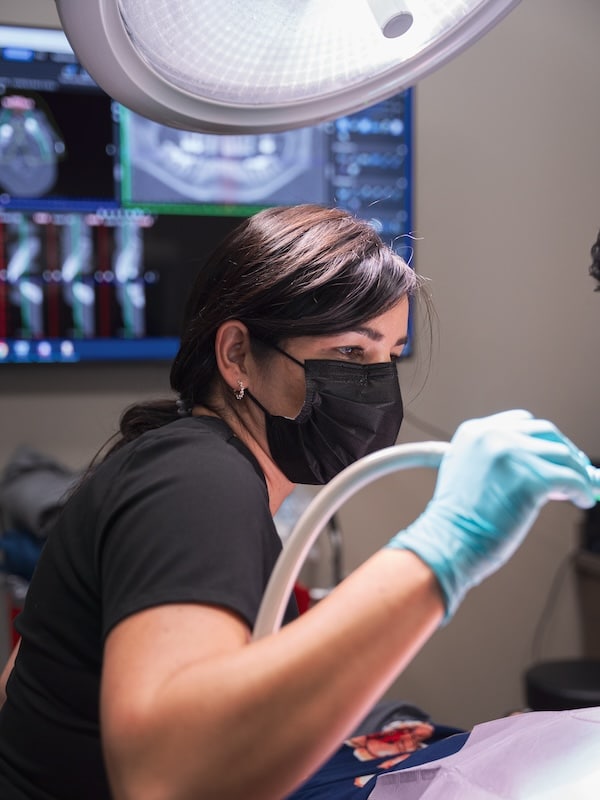
If you’ve been researching full mouth dental implants in Tennessee, you’ve likely come across both All-on-4 and All-on-6 as options. Both are fixed, permanent solutions that replace an entire arch of teeth. Both are anchored in the jawbone and function nothing like removable dentures. But there are meaningful differences between them, and understanding those differences is the first step toward making the right decision for your mouth, your health, and your long-term goals.
So what’s the real difference between All-on-4 and All-on-6? All-on-4 uses four strategically placed implants to support a full arch of teeth, while All-on-6 uses six. Neither is universally better. The right choice depends on your bone density, bite force, and anatomy, and it should always be determined by a qualified prosthodontist after a thorough evaluation.
How All-on-4 Dental Implants Work
All-on-4 dental implants in Tennessee use four titanium posts placed in the jawbone: two upright at the front and two angled at the back. That angled placement is a key feature. It allows the implants to make maximum contact with available bone, which means most patients can avoid bone grafting entirely. This makes All-on-4 a strong option for patients who have experienced some degree of bone loss, a common reality for people who have been missing teeth for an extended period.
The result is a full arch of fixed teeth, placed in a single procedure, with a temporary prosthesis the same day.
How All-on-6 Dental Implants Work
All-on-6 follows the same basic concept but uses six implants, all placed vertically. The two additional posts distribute bite force more evenly across the jaw, which can add stability and reduce stress on each individual implant over time. Because all six implants are placed upright, All-on-6 generally requires more available bone than All-on-4. Patients with strong bone density and higher bite forces may be good candidates for this approach.
Key Differences at a Glance
| Considerations | All-on-4 | All-on-6 |
|---|---|---|
| Implant Count | Four | Six |
| Placement Angle | Uses two angled posterior implants | Uses all vertical placements |
| Bone Requirements | Works well for patients with some bone loss | Typically requires more bone volume |
| Force Distribution | Less force spread than all-on-6 | Spreads chewing forces across more anchor points |
| Bone Grafting | Often eliminates the need for grafting | May require grafts in some cases |
So Which One Is Better?
Neither. The best full mouth dental implants solution is the one that fits your specific anatomy, bite, and long-term health goals. A patient with significant bone loss and moderate bite forces may be an excellent All-on-4 candidate. A patient with dense bone and a stronger bite may benefit from the additional support of All-on-6. In some cases, a prosthodontist may recommend a hybrid approach with four to six implants placed based on what the imaging reveals.
What matters most is that the decision is made by someone with the training and technology to evaluate your case accurately, not by a one-size-fits-all protocol.
How Same Day Smiles Nashville Approaches This Decision
At Same Day Smiles Nashville, Dr. Steven Park uses cone-beam CT scans to evaluate each patient’s bone volume, density, and anatomy before recommending a treatment plan. His training under Dr. Paulo Malo, the inventor of the All-on-4 technique, combined with his expertise in both surgical placement and prosthetic restoration, means your plan is built around your mouth, not a standard formula.
If you’re exploring all-on-4 dental implants in Tennessee and want to understand which approach is right for you, the best next step is a consultation. Schedule yours at Same Day Smiles Nashville today.